Logto pricing strategy: Pay-as-you-go and usage-based pricing#
As a foundational premise, Logto offers four plans: Free, Hobby, Pro, and Enterprise. The Free plan and the Enterprise plan operate differently with their own distinct approach while Hobby and Pro follow monthly usage-based pricing and are influenced by the number of Monthly Active Users (MAU).
The MAU is the primary variable that determines the monthly cost for Hobby and Pro plan subscribers.
Logto offers a transparent measurement of Monthly Active Users (MAU): An MAU refers to a user who has engaged in at least one token exchange with any Logto Cloud server within a billing cycle (30 days by default).
For most products in the market, the total monthly invoice is calculated as follows:
In the case of Logto, we introduce a tiered pricing model that allows for better segmentation of your Monthly Active Users (MAU) based on their levels of activity and engagement.
In the Logto environment, the formula for calculating the tiered MAU is as follows:
To gain a better understanding of how the formula functions, it's important to be familiar with the definitions of the variables involved.
Total Monthly Invoice: The total amount of money customers are charged for Logto services within a 30-day billing cycle.
Base Price: A fixed charge specific to each plan at the beginning of a billing cycle.
Tiered MAU: The count of monthly active users who log in to the app within a specific range of days during a billing cycle.
Tiered Unit Price: The price charged for each tiered MAU
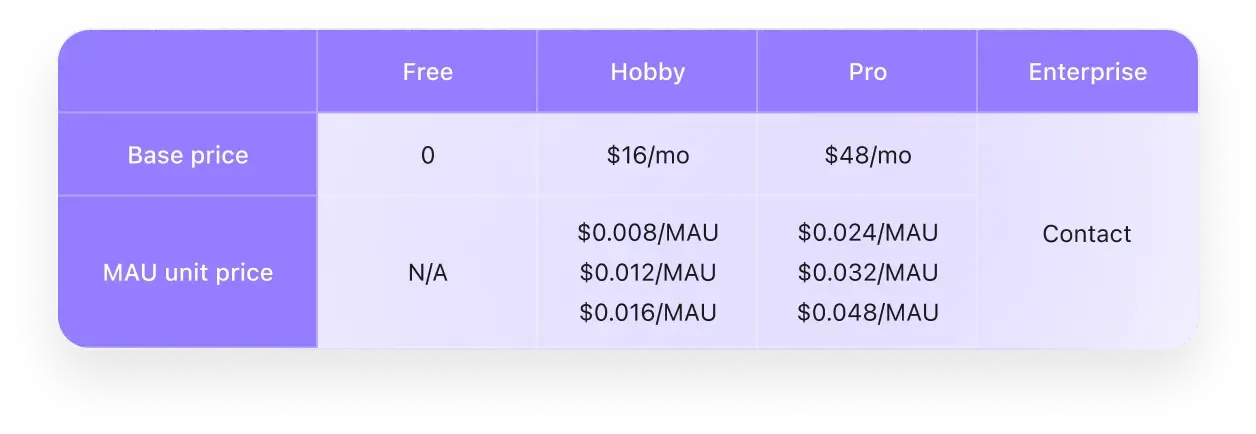
Here's a table for reference:
Tiered MAU and tiered unit prices are key aspects of our pricing model. Let's delve into the specifics to better understand them.
Imagine an app with 10,000 Monthly Active Users (MAU) and an average of 6 sign-in days. In this scenario, the app experiences an average of 2000 Daily Active Users (DAU).
Let's consider the scenario where the app runs an ad campaign to acquire new users and experiences a spike in Daily Active Users (DAU) to 40,000 on the last day of the billing cycle. As a result of the campaign, approximately 38,000 new users join the app.
The total Monthly Active Users (MAU) for this month would then increase to 38,000 (new users) + 10,000 (existing users) = 48,000.
Considering the Monthly Active Users (MAU) count of 48,000, the price would be calculated like this if we follow the industry standard pricing model:
However, this doesn’t make sense. Our customers would feel wronged. 😢
Ironically, this scenario is extremely common for early-stage startups with unstable user volumes. Therefore, in this case, Monthly Active Users (MAU) is not an accurate representation of the actual usage.
As previously mentioned, the usual Monthly Active Users (MAU) for the app is 10,000 with an average of 6 sign-in days. This segment of users falls into the Tier 2 category. The remaining 38,000 users, who joined during the spike, would most likely be classified as Tier 1 MAU since this increase represents an unusual event.
Tier 1 ($0.008/MAU)
Tier 2 ($0.012/MAU)
Tier 3 ($0.016/MAU)
38,000
10,000
0
As a result, the total monthly cost for the unusual spike in MAU can be calculated like this:
We hope this article has provided you with a thorough understanding of Logto's pricing model. Please don't hesitate to reach out if you have any questions or would like to share your thoughts.